Sunday, June 28, 2015




Sunday, June 7, 2015
Caillou and Baby Sister
Caillou and Baby Sister
Writtern by : Joceline Sanschagrin
English Version : Annette Goldsmith
As Narrated by : Kavitha Kidambi

Caillou's Mommy and Daddy come home with his Baby Sister. Caillou is very surprised. His sister can't walk. She can't eat by herself. She can't even talk. She's just a baby.


Caillou's Daddy rocks baby Rosie. Grandma and Grandpa and Auntie Caroline all say that the baby is cute. No one says Caillou is cute. Caillou sulks.


Caillou's Mommy asks if he would like to rock Rosie. But Caillou doesn't want to. He would rather play with his top.


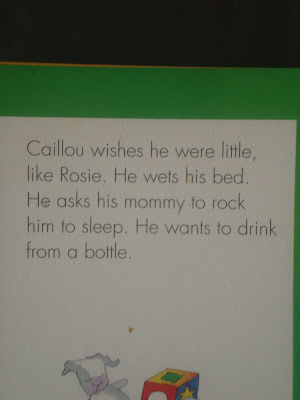
Caollou wishes he were little, like Rosie. He wets his bed. He asks his Mommy to rock him to sleep. He wants to drink from a bottle.

Caillou gives Rosie a big kiss. Then he bites her! Rosie starts to cry. Caillou is very unhappy. He is afraid someone will scold him.


Caillou's Daddy comforts Rosie. He says to Caillou, "You think your sister is sweet enough to eat. But if you do, you will no longer have her to love. You can bite an apple, but not your baby sister."


Caillou looks for his doll. It's a baby, like Rosie. He flings his doll into the air. She falls onto the floor. Then he throws his doll, smack, against the wall.


Mommy says to Caillou, "You are big and strong. You can throw your doll very far. But your sister is a baby. She can't do anything yet on her own. So we have to take care of her".


Caillou's sister is crying. She has lost her bottle. She can't find it by herself. Caillou picks up the bottle and gives it to her. Rosie stops crying.


Caillou rocks his little sister. Rosie is so funny! She is always moving. She is very small and smells so nice. Caillou likes being a Big Brother.


The End.
Moral of the Story :
The Moral of the story is Please love your little ones, don't get upset if Mom and Dad loves them, as they are so small and they can't do anything by themselves. Try to play with them safely without hurting them and they need all from you is a little care and love. That makes them feel your care and love and they will be happy.
Writtern by : Joceline Sanschagrin
English Version : Annette Goldsmith
As Narrated by : Kavitha Kidambi
Caillou and Baby Sister

Caillou's Mommy and Daddy come home with his Baby Sister. Caillou is very surprised. His sister can't walk. She can't eat by herself. She can't even talk. She's just a baby.


Caillou's Daddy rocks baby Rosie. Grandma and Grandpa and Auntie Caroline all say that the baby is cute. No one says Caillou is cute. Caillou sulks.


Caillou's Mommy asks if he would like to rock Rosie. But Caillou doesn't want to. He would rather play with his top.


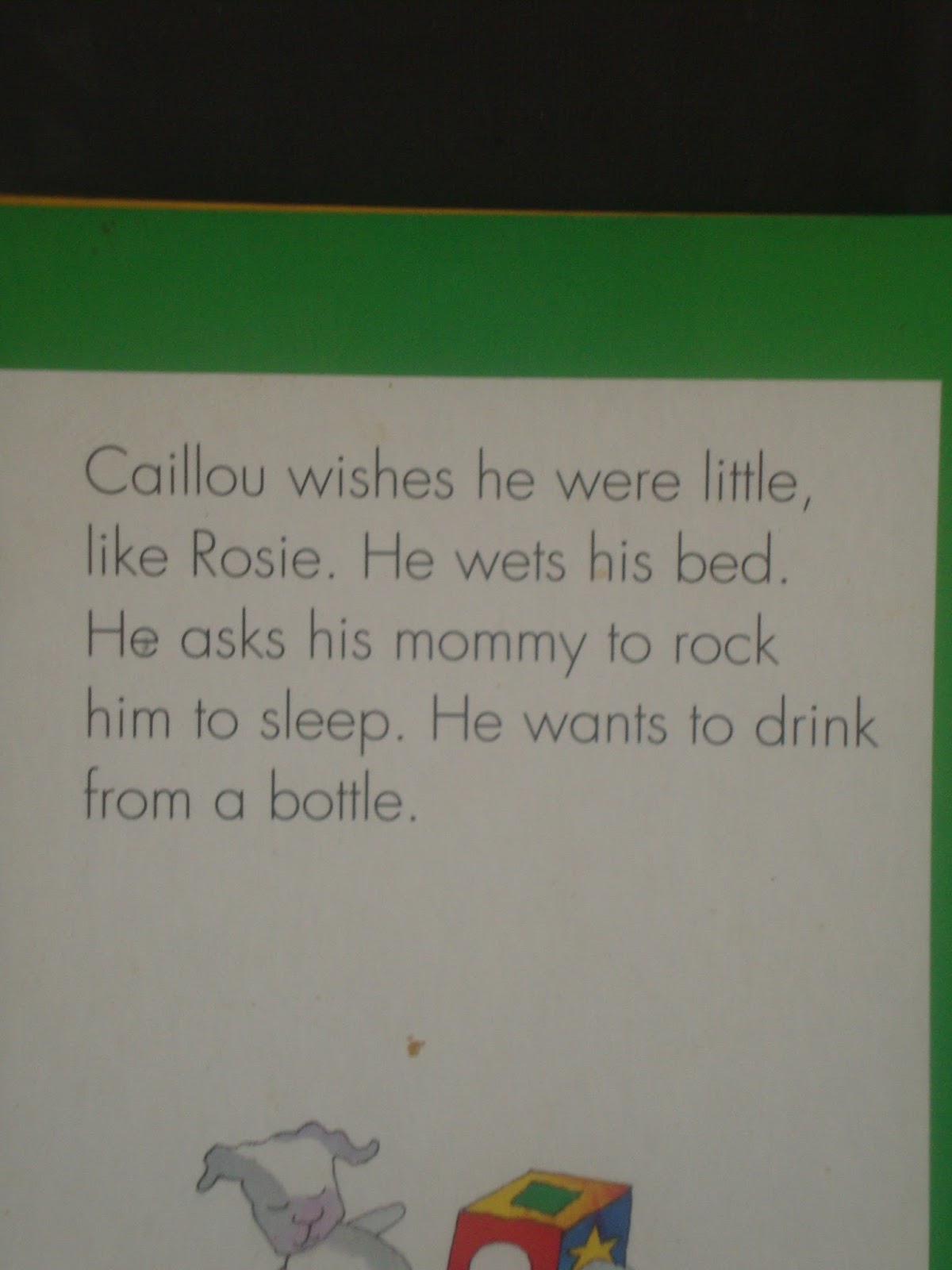
Caollou wishes he were little, like Rosie. He wets his bed. He asks his Mommy to rock him to sleep. He wants to drink from a bottle.

Caillou gives Rosie a big kiss. Then he bites her! Rosie starts to cry. Caillou is very unhappy. He is afraid someone will scold him.


Caillou's Daddy comforts Rosie. He says to Caillou, "You think your sister is sweet enough to eat. But if you do, you will no longer have her to love. You can bite an apple, but not your baby sister."


Caillou looks for his doll. It's a baby, like Rosie. He flings his doll into the air. She falls onto the floor. Then he throws his doll, smack, against the wall.


Mommy says to Caillou, "You are big and strong. You can throw your doll very far. But your sister is a baby. She can't do anything yet on her own. So we have to take care of her".


Caillou's sister is crying. She has lost her bottle. She can't find it by herself. Caillou picks up the bottle and gives it to her. Rosie stops crying.


Caillou rocks his little sister. Rosie is so funny! She is always moving. She is very small and smells so nice. Caillou likes being a Big Brother.


The End.
Moral of the Story :
The Moral of the story is Please love your little ones, don't get upset if Mom and Dad loves them, as they are so small and they can't do anything by themselves. Try to play with them safely without hurting them and they need all from you is a little care and love. That makes them feel your care and love and they will be happy.
Tuesday, May 26, 2015
Terry Fox - The Famous Canadian Hero
Terry Fox - The Famous Canadian Hero

Name : Terrance Stanley Fox
Mother : Betty Fox.
Father : Rolland Fox
Siblings : Two Brothers and One Sister
Place : Winnipeg, Manitoba
Country : Canada
Period : Born : 28th July 1958
: Died : 28th June 1981
Age : 22 years
Cause of Death : Osteogenic Sarcoma (Bone Cancer)
Title-Award : Companion of the Order of Canada

Terry Fox was born on July 28, 1958, in Winnipeg, Manitoba, to Rolland and Betty Fox. Rolland was a switchman for the Canadian National Railway. Terry had an elder brother, Fred, a younger brother, Darrell and a younger sister, Judith. He was an enthusiastic athlete, playing Soccer, Rugby and Baseball as a child. His passion was for basketball. In grade 12, he won his high school's athlete of the year award jointly with his best friend Doug Award.

On November 12, 1976, as Fox was driving home to Port Coquitlam, he became distracted by nearby bridge construction, and crashed into the back of a pickup truck. While his car was left undriveable, Fox emerged with only a sore right knee. He again felt pain in December, but chose to ignore it until the end of basketball season. By March 1977, the pain had intensified and he finally went to a hospital, where he was diagnosed with Osteosarcoma, a form of cancer that often starts near the knees. Fox believed his car accident weakened his knee and left it vulnerable to the disease. He was told that his leg had to be amputated, he would require chemotherapy treatment, and that recent medical advances meant he had a 50 percent chance of survival. Fox learned that two years before the figure would have been only 15 percent; the improvement in survival rates impressed on him the value of cancer research.

An active teenager involved in many sports, Terry was only 18 years old when he was diagnosed with Osteogenic Sarcoma (Bone Cancer) and forced to have his right leg amputated 15 centimetres (six inches) above the knee in 1977. While in hospital, Terry was so overcome by the suffering of other cancer patients, many of them young children, that he decided to run across Canada to raise money for cancer research. He would call his journey the Marathon of Hope. It was a journey that Canadians never forgot.

In
the summer of 1977, Rick Hansen, working with the Canadian Wheelchair
Sports Association, invited Fox to try out for his wheelchair basketball
team. Although he was undergoing chemotherapy treatments at the time,
Fox's energy impressed Hansen. Less than two months after learning how
to play the sport, Fox was named a member of the team for the national
championship in Edmonton. He won three national titles with the team,
and was named an all-star by the North American Wheelchair Basketball
Association in 1980.

After
18 months and running over 5,000 kilometres (3,107 miles) to prepare,
Terry started his run in St. John’s, Newfoundland on April 12, 1980 with
little fanfare. Although it was difficult to garner attention in the
beginning, enthusiasm soon grew, and the money collected along his route
began to mount. He ran close to 42 kilometres (26 miles) a day through
Canada's Atlantic provinces, Quebec and Ontario. However, on September
1st, after 143 days and 5,373 kilometres (3,339 miles), Terry was forced
to stop running outside of Thunder Bay, Ontario because cancer had
appeared in his lungs. An entire nation was stunned and saddened. Terry
passed away on June 28, 1981 at the age 22 one month before his 23rd
birthday. The Marathon of Hope had collected $24.17 million, enough to
have met his goal.Terry The Heroic Canadian was gone, but his legacy was
just beginning.


Fox's
story was dramatized in the 1983 biopic The Terry Fox Story. Produced
by Home Box Office, the film aired as a television movie in the United
States and had a theatrical run in Canada. The film starred amputee
actor Eric Fryer and Robert Duvall, and was the first film made
exclusively for pay television. The Terry Fox Story was nominated for
eight Genie Awards, and won five, including Best Picture and Best Actor.
A
second movie, titled Terry, focused on the Marathon of Hope, was
produced by the CTV Television Network in 2005. Fox was portrayed by
Shawn Ashmore. He is not an amputee; digital editing was used to
superimpose a prosthesis over his real leg. The film was endorsed by
Fox's family, and portrayed his positive attitude. Canadian National
Basketball Association star Steve Nash, who himself was inspired by Fox
when he was a child, directed a 2010 documentary Into the Wind, which
aired on ESPN as part of its 30 for 30 series.
Every
September thousands of people, in 60 different countries, take to the
streets to run and to continue the dream of a single man. Who could have
inspired such participation and what was his cause? The man was
Canadian Terry Fox and the cause was to raise money for cancer research.
It began when Terry Fox was diagnosed with osteogenic sarcoma, a form
of bone cancer. His right leg was amputated six inches above the right
knee. Always an athlete, once Terry recovered he resolved to run across
Canada with the goal of collecting one dollar for every Canadian. Terry
began his "Marathon of Hope" on April 12, 1980 as he dipped his
artificial foot in the Atlantic Ocean. He hoped to dip the same foot in
the Pacific at the end of his run. However, the grueling pace that Terry
set for himself, through rain or shine, was cut short when doctors
discovered that cancer had spread to his lungs.

Honours
September 18, 1980 - Governor General Edward Schreyer presents Terry Fox with the Companion of the Order of Canada. He is the youngest recipient of the award.

December 18, 1980 - Sports editors present Terry with the Lou Marsh Awardfor his outstanding athletic accomplishment.
December 23, 1980 - The editors of Canadian Press member newspapers and the radio and television stations vote Terry, Canadian of the Year.
June 6, 1981 - Simon Fraser University awards Terry the first annual Terry Fox Gold Medal. It is awarded annually to a student showing courage in the face of adversity, as exemplified by Terry Fox, himself, a former student of the university.
July 17, 1981 - British Columbia designates a 2,639-metre (8,658-foot) peak in the Rocky Mountains as Mount Terry Fox.
July 30, 1981 - The 83-kilometre (52-mile) section of the Trans-Canada Highway, between Thunder Bay and Nipigon, is re-named Terry Fox Courage Highway.
July 30, 1981 - The Canadian government creates a $5 million endowment fund to provide scholarships each year called the Terry Fox Humanitarian Award.
August 29, 1981 - Terry is inducted into the Canadian Sports Hall of Fame.
April 13, 1982/Jan 17, 2000 - A Terry Fox Stamp is issued by Canada Post; prior to this no commemorative stamp had been issued until 10 years after the death of the honouree.
June 26, 1982 - The Thunder Bay Monument, a 2.7-metre (9-foot) bronze statue of Terry, is unveiled at Terry Fox lookout west of Thunder Bay, Ontario. It is re-dedicated in Ottawa in 1998 and is part of the Path of Heroes.
June 30, 1999 - Terry Fox is voted Canada’s Greatest Heroin a national survey.
July 1, 1998 - The Terry Fox Monumentis re-dedicated in Ottawa, ON and is now part of the ‘Path of Heroes’.
January 27, 2003 - Time Magazine includes Terry in a story called Canada’s Best.
March 14, 2005 - The Terry Fox one dollar coinis unveiled. Terry is the first Canadian to be featured on a circulation coin.
April 12, 2005 - “Terry”, a pictorial book by Doug Coupland, debuts at #1 on the Canadian bestseller list.
September, 2005 - Terry Fox statuesin Port Coquitlam, Victoria, and Prince George, British Columbia are unveiled.
September 11, 2005 - “Terry”A new TV movie airs with an audience of 1.6 million.
October 29, 2007 - The Terry Fox Research Instituteis launched, combining the clinical knowledge of cancer physicians with advanced laboratory expertise of scientific researchers, overcoming barriers of discipline and geography.
February 27, 2010 - The 2010 Vancouver Olympic Organizing Committee creates the Terry Fox Award, presented to an athlete who embodies the values that Terry did, showing determination and humility in the face of obstacles. It is awarded to Canadian figure skater Joannie Rochette and Slovenian cross-country skier Petra Majdic.
September 10, 2010 – Canadian basketball star Steve Nash directed “Into the Wind,” an installment of ESPN’s “30 for 30” series. It played on TSN to rave reviews and ESPN donated more than 10,000 copies to Canadians schools.
September 16, 2011 - A new Terry Fox Memorialis unveiled at BC Place in Vancouver. The memorial consists of four individual sculptures, replicating Terry’s running gait, created by renowned artist, Douglas Coupland.
March 28, 2012 - The Canadian Medical Hall of Fameinducts Terry, recognized as a “builder” for his work to raise money for cancer research. Terry is the youngest-ever inductee into the CMHF and the first whose achievements were non-professional.
April 12, 2012 - A new bronze sculpture, depicting the moment Terry began his journey by dipping his artificial leg into the ocean, marking Mile 0, was dedicated in St. John’s, NL.
March 18, 2014 - Many Canadians proudly wear their Terry Fox shirts when travelling around the globe. Now we will all be carrying a little something else "Terry" on our international travels. Passport Canada announced a new epassport which celebrates Canadian history. An image of the iconic Terry Fox Monument in Ottawa can be found on page 31. So make sure when you get your new passport and take your first trip, ask the Immigration Agent to stamp page 31 first!
December 23, 1980 - The editors of Canadian Press member newspapers and the radio and television stations vote Terry, Canadian of the Year.
June 6, 1981 - Simon Fraser University awards Terry the first annual Terry Fox Gold Medal. It is awarded annually to a student showing courage in the face of adversity, as exemplified by Terry Fox, himself, a former student of the university.
July 17, 1981 - British Columbia designates a 2,639-metre (8,658-foot) peak in the Rocky Mountains as Mount Terry Fox.
July 30, 1981 - The 83-kilometre (52-mile) section of the Trans-Canada Highway, between Thunder Bay and Nipigon, is re-named Terry Fox Courage Highway.
July 30, 1981 - The Canadian government creates a $5 million endowment fund to provide scholarships each year called the Terry Fox Humanitarian Award.
August 29, 1981 - Terry is inducted into the Canadian Sports Hall of Fame.
April 13, 1982/Jan 17, 2000 - A Terry Fox Stamp is issued by Canada Post; prior to this no commemorative stamp had been issued until 10 years after the death of the honouree.
June 26, 1982 - The Thunder Bay Monument, a 2.7-metre (9-foot) bronze statue of Terry, is unveiled at Terry Fox lookout west of Thunder Bay, Ontario. It is re-dedicated in Ottawa in 1998 and is part of the Path of Heroes.
June 30, 1999 - Terry Fox is voted Canada’s Greatest Heroin a national survey.
July 1, 1998 - The Terry Fox Monumentis re-dedicated in Ottawa, ON and is now part of the ‘Path of Heroes’.
January 27, 2003 - Time Magazine includes Terry in a story called Canada’s Best.
March 14, 2005 - The Terry Fox one dollar coinis unveiled. Terry is the first Canadian to be featured on a circulation coin.
April 12, 2005 - “Terry”, a pictorial book by Doug Coupland, debuts at #1 on the Canadian bestseller list.
September, 2005 - Terry Fox statuesin Port Coquitlam, Victoria, and Prince George, British Columbia are unveiled.
September 11, 2005 - “Terry”A new TV movie airs with an audience of 1.6 million.
October 29, 2007 - The Terry Fox Research Instituteis launched, combining the clinical knowledge of cancer physicians with advanced laboratory expertise of scientific researchers, overcoming barriers of discipline and geography.
February 27, 2010 - The 2010 Vancouver Olympic Organizing Committee creates the Terry Fox Award, presented to an athlete who embodies the values that Terry did, showing determination and humility in the face of obstacles. It is awarded to Canadian figure skater Joannie Rochette and Slovenian cross-country skier Petra Majdic.
September 10, 2010 – Canadian basketball star Steve Nash directed “Into the Wind,” an installment of ESPN’s “30 for 30” series. It played on TSN to rave reviews and ESPN donated more than 10,000 copies to Canadians schools.
September 16, 2011 - A new Terry Fox Memorialis unveiled at BC Place in Vancouver. The memorial consists of four individual sculptures, replicating Terry’s running gait, created by renowned artist, Douglas Coupland.
March 28, 2012 - The Canadian Medical Hall of Fameinducts Terry, recognized as a “builder” for his work to raise money for cancer research. Terry is the youngest-ever inductee into the CMHF and the first whose achievements were non-professional.
April 12, 2012 - A new bronze sculpture, depicting the moment Terry began his journey by dipping his artificial leg into the ocean, marking Mile 0, was dedicated in St. John’s, NL.
March 18, 2014 - Many Canadians proudly wear their Terry Fox shirts when travelling around the globe. Now we will all be carrying a little something else "Terry" on our international travels. Passport Canada announced a new epassport which celebrates Canadian history. An image of the iconic Terry Fox Monument in Ottawa can be found on page 31. So make sure when you get your new passport and take your first trip, ask the Immigration Agent to stamp page 31 first!

Subscribe to:
Posts (Atom)